
aBeLOG
Welcome to the aBeLOG, a series of (hopefully!) fortnightly posts on all matters homiletical. I intend to touch on whatever grabs my attention regarding preaching—issues contemporary and ancient, ideas hermeneutical and rhetorical, personalities conservative and liberal, publications antiquarian and avant-garde. Essentially, I’m going to follow my own homiletical olfactory instincts up rabbit trails and after red herrings. Comments are always invited and appreciated.
Mark 15:40−16:8
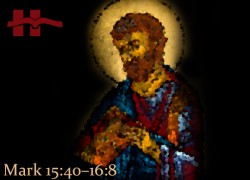
Disciples restored by God’s grace continue to be faithful to Jesus, ready to undertake another round of the journey of discipleship with Jesus.
“But go, tell His disciples and Peter, ‘He is going ahead of you to Galilee; there you will see Him, just as He told you.’”
And going out, they [the women] fled from the tomb, for trembling and terror had seized them; and they said nothing to anyone, for they were afraid.
Mark 16:7–8
This final portion of Mark functions
Walt Kaiser: How I Preach
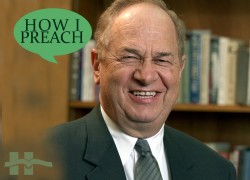
Walt Kaiser: And this is How I Preach …
[Walt is a giant—in more ways than one! Past President of Gordon-Conwell, he has been involved in every stripe of evangelical scholarship, dispatching his remarks, scripting his papers, responding to questioners, with panache and pizzazz, energy and élan, zest and wit! For the last forty years! I have had the privilege to share podiums with him at meetings of the Evangelical Theological Society. For all his acumen and erudition,
Interview on Genesis: A Theological Commentary for Preachers

Here’s a recent interview of me conducted by my friend and once-Seminary-classmate, Dr. Charles Savelle. It ran the other day on his informative blog that deals with all matters related to Bible exposition. I’ve borrowed it off his website; you can find the interview here.]
CS: How did Genesis: A Theological Commentary for Preachers come about?
AK: Well, I’m on a crusade! I have been engaged in laying out a somewhat new hermeneutic for approaching
Stuart Briscoe: How I Preach
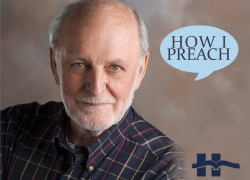
Stuart Briscoe: And this is How I Preach …
[Stuart and I shared a pulpit a few months ago at Moody Bible Institute’s Founder’s Week in Chicago. There, I persuaded him to let us in on his preaching techniques and schemes. The man has been preaching for almost seven decades. And he’s still going strong, teaching the Bible across oceans and on every continent, after having pastored Elmbrook Church, in Brookfield, Wisconsin, the largest church in that state, for thirty
A New Commentary!

This is a rehash of an old post, to announce my new commentary that’s just come out: Genesis: A Theological Commentary for Preachers.
I’m frequently asked by my students about commentaries I employ in my preaching prep.
The Preacher sought to find delightful words and to write words of truth correctly. The words of wise men are like goads, and masters of these collections are like well-driven nails; they are given by one Shepherd. But
Don Sunukjian: How I Preach
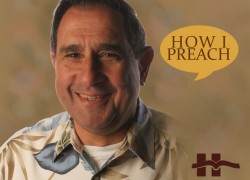
Don Sunukjian: And this is How I Preach …
[I’m happy to present Don Sunukjian on How I Preach. He has been in ministry for close to four decades now and has left an indelible mark on evangelical homiletics, including that taught at Dallas Seminary, where he was a prof in the 80s.]
Donald R. Sunukjian
Professor of Preaching
Chair, Department of Christian Ministry and Leadership
Talbot School of Theology, La Mirada, California
Current gig
Mark 15:1−39
Faithfulness to Jesus involves sacrifice and suffering ridicule as part of submitting to his ultimately victorious kingship!
The centurion, who was standing by in front of Him … said, “Truly this man was the Son of God!”
Mark 15:39
The account is peppered with the sardonic attribution of “kingship” to Jesus. But there is irony here: from Mark’s inkwell, Jesus’ kingship becomes a powerful truth—sarcastically affirmed by the scoffers, but true nonetheless
 Abe Kuruvilla is the Carl E. Bates Professor of Christian Preaching at The Southern Baptist Theological Seminary (Louisville, KY), and a dermatologist in private practice. His passion is to explore, explain, and exemplify preaching.