
RaMbLeS
Welcome to RaMbLeS, a collection of weekly musings on life and Scripture. It all began in 2005 on Google’s blogspot as the aBeLOG (a name now recycled), a semi-autobiographical devotional that attempted to keep well-wishers abreast of my activities as I relocated to Scotland for a few years. Since my return, I’ve continued my RaMbLeS, and here’s its most recent incarnation on Homiletix, as random reflections usually based on current news articles and travel experiences and whatever else takes my fancy!
Positivity?

Glass half full or half empty? That depends on the mindset of the one looking, right?
For the “half empty” folks, there is a term for the pessimism they espouse: toxic negativity. We intuitively know that toxic negativity ain’t good for you or those around you.
Then there are those “half full” folks, who always see the shining light on those storm clouds, claiming, “Well, at least it is not …” or “Look on the bright side ….” Etc. That kind of attitude
Nostalgia?

In the West Midlands of England, in Hagley Park, you’ll find what looks like big ol’ ruin. Kinda like a Gothic castle, complete with four corner towers, three of them falling apart, one still standing with battlements and turret. Many walls connecting the towards have collapsed.
What ancient building is this, you wonder? Who lived here? What stories could the walls tell, if there were more walls? And why was it abandoned?
You would wonder for ever, because there is no
Direction?

Oops!
Recently, a Nepalese airline, Buddha Air, accidentally flew to the wrong airport!
(Yes, there is such an airline. It began flying in 1997 and operates a fleet of about a dozen turboprop aircraft out of cities in Nepal, mostly doing domestic runs, plus the occasional international flight to neighboring India.)
A week before Christmas, on December 18, 2020, Buddha operated flight U4505 with 69 passengers. It was supposed to fly from the capital Kathmandu to Janakpur,
Works!

A few years ago, an enterprising writer for The Atlantic, Philip Bump, decided to tackle a laborious task. Does Santa really work hard?
I decided to figure out how many, how big a task Mr. Claus faces as he races west across the face of the globe, staying ahead of the sun. And I did. Or, anyway, I came up with a pretty solid estimate.”
Spoiler: He does work hard.
Assuming, of course, that he exists and that on Christmas Eve he canters around the globe (or his reindeer do)
Loneliness?

The holidays are lonely times for a lot of folks, especially this year of the pandemic, what with lockdowns and distancing. A 2018 study from Cigna found 54 percent of Americans confessing loneliness. In a couple of years that had grown to 61 percent!
But there is good news: loneliness may actually be good for you!
So claim scientists from McGill University in “The Default Network of the Human Brain is Associated with Perceived Social Isolation,” published recently in
Nociceptive?

All kinds of nerve endings on our skin pass specialized information on to our brain. Most have specialized “end-organ structures,” nerve endings shaped and adapted to respond to temperature, chemicals, touch, position, vibration, etc. Then there are also free nerve endings—that just end in the skin without any “end-organ structure”—these are the commonest nerve endings in the skin. For over a century, these free nerve endings had been thought to transmit pain
Height!
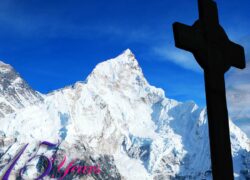
The Nepalese call it Sagarmatha, “Peak of Heaven.” The Tibetans, Chomolungma, “Mother Goddess of the World.” Most others call it “Everest,” after Sir George Everest, the British Surveyor General of India in the mid 1800s. Though it was an Indian mathematician and surveyor, Radhanath Sikdar, who was first to discover it was the highest mountain in the world, at 29,029 feet.
Said Roxanne Vogel, 35, one of the more recent of Everest’s conquerors:
That’s
 Abe Kuruvilla is the Carl E. Bates Professor of Christian Preaching at The Southern Baptist Theological Seminary (Louisville, KY), and a dermatologist in private practice. His passion is to explore, explain, and exemplify preaching.