
Stripes?
In 1901, Rudyard Kipling , in How the Leopard Got His Spots, observed in jest:
[The animals] came to a great forest, ‘sclusively full of trees and bushes and stripy, speckly, patchy-blatchy shadows, and there they hid: and after another long time, what with standing half in the shade and half out of it, and what with the slippery-slidy shadows of the trees falling on them, the Giraffe grew blotchy, and the Zebra grew stripy.”
OK, but why? What advantage do those stripes give those zebras? Nope, it’s not to confuse predators. Zebras spend most of their time in open spaces where their stripes are conspicuous; lions have no trouble eating lots of zebras.
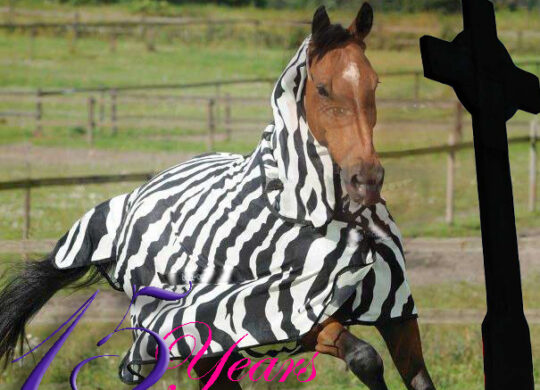
Last year, evolutionary biologists from the University of California, Davis, with collaborators from the UK, spent some time in a horse livery yard in Bristol, UK. They dressed up several horses in zebra-striped gowns and studied them alongside actual zebras.
To cut to the chase, here’s what they found: stripes deter biting flies! Far fewer flies landed on zebras—or horses with striped coats.
Said Tim Caro, an ecologist from the University of St Andrews, lead author on the study: “Benefits of Zebra Stripes” published in PLOS|One:
The flies would try to land on the stripes, but then fail to decelerate as they normally would approaching a non-striped surface, and bounce off. It looks as if they cannot recognize that black and white surface as a good landing spot.”
Caro and Co. are working with “lots of unpublished data” from videos of flies approaching different patterns to learn how the stripes mess up a fly’s landing.
I quite like the idea of deterring predators. And we do have a lot of them, in a lot of different forms, from a lot of different places, creating a lot of different problems for us, generating lots of fear.
Lord, how many my adversaries have become!
Many [are] rising against me.
Psalm 3:1
“Many” and “many.” In fact, “ten thousand”!
… ten thousand people …
have set [themselves] against me all around.
Psalm 3:6
“Many … have become” is the Hebrew verb rbb; “many” (the noun) is rabbim, and “ten thousand” is rbabah, creating a nice wordplay.
And notice in 3:1, that “Lord” and “me” are separated in the verse by the intervening “many” and “many.” Real life in poetry!
And that’s not all. These enemies (another “many”) taunt the believer:
Many [are] saying about my soul,
“There is no deliverance for him in God.”
Psalm 3:2
Are they right? Has God abandoned us? What is one to do? Grow stripes?
Well, those adversaries are very, very wrong!
But You, Yahweh, [are] a shield about me;
my glory, and the One who lifts my head.
Psalm 3:3
So, without any recourse to stripes, …
With my voice, to Yahweh I called out,
and He answered me from His holy mountain.
Psalm 3:4
And …
I—I lay down and I slept;
I awoke, for Yahweh—He sustains me.
Psalm 3:5
And the fate of the enemies? Dire!
For You have smitten all my enemies on the jaw;
the teeth of the wicked You have shattered.
Psalm 3:7
Poetically speaking, with mandibles smashed and teeth crushed (not to mention mouths flooded with blood), they who had insulted the psalmist and his God, were going to find it a bit difficult to give an encore.
So, no need to fear, Because, unlike what the enemies had asserted, …
To Yahweh [belongs] deliverance;
upon Your people, Your blessing!
Psalm 3:8
No need for stripes! We’re safe!
SOURCES:
BBC; PLOS|One
 Abe Kuruvilla is the Carl E. Bates Professor of Christian Preaching at The Southern Baptist Theological Seminary (Louisville, KY), and a dermatologist in private practice. His passion is to explore, explain, and exemplify preaching.