
Diagnosis?
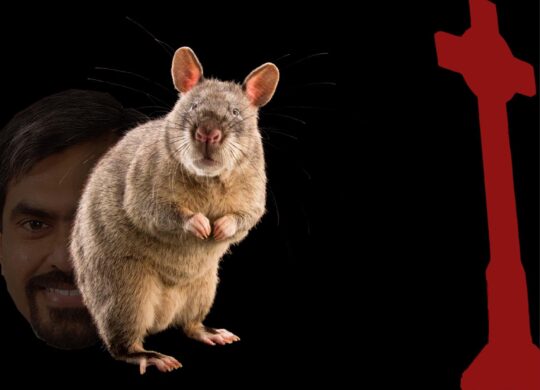
That is the African Giant Pouched Rat (aka Cricetomys gambianus). An incredible rodent: it has been trained to smell out land mines in some parts of Africa. But here’s a new one: it is now capable of smelling out tuberculosis, too. We have, in short, a better diagnostician. Take that, doctors! A lab rat has done us better!
Every weekday, this trained rodent, named Tariq, and eight of his brethren take turns in a cage at Eduardo Mondlane University’s College of Veterinary Medicine (Maputo, Mozambique). Underneath the cage floor, a removable tray with ten samples of human mucus is inserted. Tariq walks the length of the cage, scratching the floor when he suspects that a sample is positive for tuberculosis (TB). He works rapidly, taking only eight minutes to get through five trays containing a total of 50 samples.
Said Tariq’s trainer, Catia Souto:
Rats are very fast. One rat can evaluate more samples in ten minutes than a lab technician can evaluate in a day.”
TB claims a half a million lives a year in Africa, and these rats, trained for nine months, provide an innovative, rapid, and affordable detection technique. The other option: trained lab technicians using microscopes to look at mucus, or sputum, samples of potentially infected patients to see if TB bacteria are present.
Associate rat trainer, Lila Denis:
Lab technicians can make mistakes. And people can die because of that.”
Emilio Valverde, manager of Mozambique’s TB Program:
What the rats are trained to do is associate the smell of TB with a reward, so it’s what they call operative conditioning. It is the same principle applied to detecting land mines, only the rats are trained to recognize the scent of specific molecules that reflect the presence of the tuberculosis germ—not the explosive vapor associated with land mines. And each rat costs around $6,700 to $8,000 to train, but relatively little to maintain over their six-to-eight-year life span.”
When the rat alerts by scratching at a known sample, a buzzer is sounded and the rat is rewarded with a treat. Any suspect samples are triple-checked, and if found to be positive, they’re reported back to the clinics.
But there are problems, said Ivan Manhiça, of the health ministry of Mozambique:
First we have to confirm, to have evidence enough, this technique works. Then we would have to discuss the logistics, because there are some regions, some districts where people eat rats.”
No, you don’t want people eating their “doctors.”
What’s more, only 25% of the samples the rats find suspicious are found to be positive for TB by standard tests. This does not mean they are negative, but they cannot be reported as positive because Dr. Rat’s opinion by itself is not yet medically valid.
In any case, the only substantive refuge for all diseases is God himself:
I will say to Yahweh, “My refuge and my steadfastness, My God, I trust in Him.”
For He it is who rescues you from the fowler’s trap [and] from the ruinous plague.
With His pinion He gives cover to you, and under His wings you can seek refuge;
a shield and a bulwark is His faithfulness.
You will not be in fear from the terror of night, from the arrow that flies by day,
from the plague that stalks in darkness, from the destruction that devastates at noontimes.
Psalm 91:1–6
So …
Bless Yahweh, my soul, and do not forget all His bestowments—
the One who pardons all your iniquities, the One who heals all your diseases.
Psalm 103:2–3
SOURCE: National Geographic
 Abe Kuruvilla is the Carl E. Bates Professor of Christian Preaching at The Southern Baptist Theological Seminary (Louisville, KY), and a dermatologist in private practice. His passion is to explore, explain, and exemplify preaching.