
Fixed!
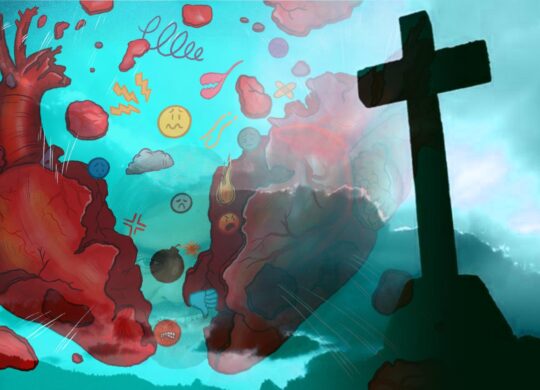
Takotsubo cardiomyopathy (aka the “broken heart” disease) is a sudden weakening of the cardiac muscle in the left ventricle that can be triggered by conditions causing a “broken heart”—death, break-ups, extreme stress. A surge of stress hormones flood the heart during such traumatic events. That causes changes in the heart muscles and blood vessels which prevent the left ventricle from working properly. The result is the heavy, achy feeling people get in the chest that can be mistaken for a heart attack.
Studies following patients with Takotsubo (that word comes from the Japanese for an octopus trap that resembles the disabled left ventricle in those afflicted) discovered that ten percent of suffers die within five years of diagnosis.
It had been thought that the disease had long-lasting damaging effects on the hearts of those who suffered from it. Cardiac function appeared to be permanently affected, with a form of scarring of the muscle indicating that full recovery was rare.
Well, scientists may have to rethink that notion.
Australian researchers from Monash University, Melbourne, the Hong Kong Institute of Diabetes and Obesity, and from University College Copenhagen said so in “SAHA Attenuates Takotsubo-like Myocardial Injury by Targeting an Epigenetic Ac/Dc Axis,” in Signal Transduction and Targeted Therapy.
SAHA is suberanilohydroxamic acid. Approved by the US FDA for cancer, it apparently works in Takotsubo cardiomyopathy by protecting certain genes and by causing chemical changes therein (acetylation/deacetylation—Ac/Dc—nope, nothing to do with electricity as I first thought when I saw the title) and affecting the expression of such genes, particularly relating to collagen and scarring.
All the experimental work was done on mice, with induction of cardiomyopathy by isoproterenol (ISO):
ISO significantly increased collagen content in the infarcted left ventricle. SAHA treatment attenuated ISO-induced injury by decreasing collagen.”
Reported study leader Professor Sam El-Osta from Monash:
We show for the first time a drug that shows preventative and therapeutic benefit is important to a healthy heart. The drug not only slows cardiac injury, but also reverses, the damage caused to the stressed heart. In conclusion, compounds like SAHA that have cardioprotective benefits for broken-heart syndrome.”
Maybe so, but the Bible promises a better “drug”:
Yahweh is near to the brokenhearted,
and those crushed in spirit He delivers.
Psalm 34:18
That this is not just for some elites or some of God’s favorites is clear from the thrice-repeating refrain of Psalm 34 (patterned in each case as desperate plea + divine response + dire situation + divine deliverance, as each line of the three verses shows, below).
First, in the first-person singular:
I sought Yahweh,
and He answered me,
and from all my terrors
He rescued me.
Psalm 34:4
Second, in the third-person singular:
This afflicted one cried,
and Yahweh heard,
and from all his distresses
He delivered him.
Psalm 34:6
And third, in the third-person plural:
They wail,
and Yahweh hears,
and from all their distresses
He rescues them.
Psalm 34:17
All his people he hears, and he rescues them from all their woes! Broken hearts cured!.
Yahweh is near to the brokenhearted,
and those crushed in spirit He delivers.
Psalm 34:18
Indeed, not only does God hear and answer, the angel of Yahweh forms a protective cordon around “those who fear Him [God]” and saves them:.
The angel of Yahweh encamps around those who fear Him,
and saves them.
Psalm 34:7
Yes, fear Yahweh, the savior of the broken-hearted:
Fear Yahweh, you His holy ones;
for there is no lack to those who fear Him.
Psalm 34:9
Amen!
SOURCES:
Study Finds; Signal Transduction and Targeted Therapy
 Abe Kuruvilla is the Carl E. Bates Professor of Christian Preaching at The Southern Baptist Theological Seminary (Louisville, KY), and a dermatologist in private practice. His passion is to explore, explain, and exemplify preaching.