
Mobility?
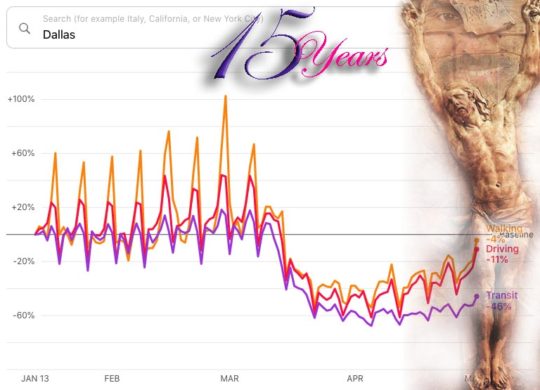
Last month Apple released a “Mobility Data Trends Tool.”
The company is utilizing data coming from its iPhones, more precisely from its Maps app. The information is generated by analyzing requests for directions made by you and me and millions of others to Apple Maps. Data sets, current and historical, are compared to show changes in the volume of people driving, walking, or taking public transportation.
Apple’s assurance:
Privacy is one of our core values, so Maps doesn’t associate your data with your Apple ID, and Apple doesn’t keep a history of where you’ve been.”
Over 60 different countries, and hundreds of regions and cities are featured and can be searched. Values are plotted from mid-January and are updated daily.
In Dallas, TX, as of yesterday, courtesy of COVID-19, walking had diminished by 4%, driving by 11%, and public transit by 46% (though things seem to be moving upward).
The Bible has a lot to say about mobility, especially the kind directed upwards.
In the Gospel of Mark—twice!—each time after Jesus had predicted his death, the disciples, who apparently couldn’t care less, were caught worrying about upward mobility.
And when He [Jesus] was in the house, He asked them,
“What were you arguing on the way?”
But they kept silent; for on the way they had argued with each other
[about] who was the greatest.
And sitting down, He called the Twelve and said to them,
“If anyone wishes to be first, he shall be last of all and servant of all.”
Mark 9:33–35
The Twelve were looking out for themselves and they, like all of us, would rather have the glory and be mobile upwards.
All that stuff about death? Who wants to accept those unappetizing aspects of Jesus’ mission? That’s downward mobility!”
In reply to the disciples’ self-engrossment and ambition, Jesus makes a profound statement about true upward mobility: the highest status in the kingdom of God is appointed for those who are last of all and who are servants of all.
This was nothing but a drastic reversal of the conventional scale of values and a complete overturning of the disciples’ pursuit of upward mobility—powered by pride. In other words, being servant to the least is perhaps the most significant attitude a disciple could adopt, in stark contrast to the arrogant yearning for prestige and honor.
Augustine’s observation is apt:
Observe a tree, how it first tends downwards, that it may then shoot forth upwards. It fastens its root low in the ground that it may send forth its top toward heaven. Is it not from humility that it endeavors to rise? But without humility it will not attain to higher things. You are wanting to grow up into the air without a root. Such is not growth, but a collapse.”
But whoever wants to become great among you shall be your servant,
and whoever wants to be first among you shall be slave of all.
For even the Son of Man did not come to be served,
but to serve and to give His life a ransom for many.”
Mark 10:42–45
Jesus himself sets up the model for us to follow, not to give our lives as a ransom, of course, but to do so for Jesus’ mission and for the sake of the Gospel. Pursuits of upward mobility à la the world are completely antithetical to the ways of God and the principles of his kingdom.
Mobility may have gone downward with COVID-19. But for the child of God, mobility is always upward … by going downward.
SOURCE:
Apple.com
 Abe Kuruvilla is the Carl E. Bates Professor of Christian Preaching at The Southern Baptist Theological Seminary (Louisville, KY), and a dermatologist in private practice. His passion is to explore, explain, and exemplify preaching.