
Nails!
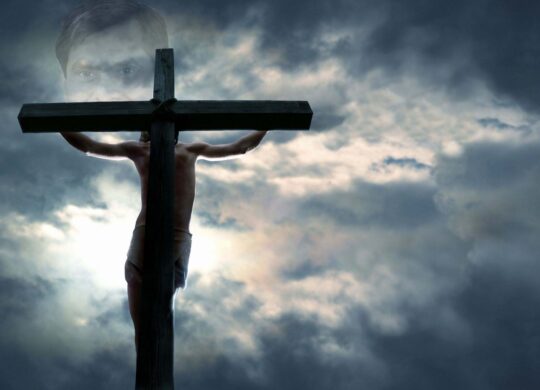
A few decades ago, they found Caiaphas’s tomb. While workers creating a new water park on the outskirts of Jerusalem were digging, suddenly the ground gave way before them, unearthing a burial cave with a collection of 12 ossuaries— limestone urns used to store the bones of the dead. The coins found in the urns dated them to around 40 AD—2000 years old. One particular ossuary was an elaborate one, ornately decorated with an intricate pattern of rosettes. It obviously contained the bones of a man of high position. And indeed it did, for on the ossuary was a name—the name of a Jewish man of great influence in the first century, the name of a man of immense religious prominence to the Jews, the name of the High Priest and chief of the supreme council of the Jews, the name of the man who literally signed the death warrant of Jesus Christ: Joseph ben Caiaphas (c. 14 BC– c. 46 AD).
Curiously enough, there were nails in the cave, too. But at some point after the excavation of the ossuaries, those nails went missing. Years later, filmmaker Simcha Jacobovici claimed to have found them, even alleging that those were the very nails that had been used to crucify Jesus himself. All this he disclosed in his 2011 documentary, Nails of The Cross.
That, anyhow, was strongly discounted by scholars, who denied that Jacobovici’s nails were the ones from Caiaphas’s tomb.
But late in 2020 an explosive new study has concluded that the nails are indeed the same ones. Lead author, Dr Aryeh Shimron, a retired Jerusalem-based geologist, made the jaw-dropping find after comparing material from the nails with material from the tomb’s ossuaries.
Shimron:
The materials invading caves differ subtly from cave to cave depending on topography, soil composition in the area, the microclimate and neighboring vegetation. Consequently, caves have distinct physical and chemical signatures. The physical and chemical properties of the materials which, over centuries, have invaded the tomb and its ossuaries were investigated. Our analysis clearly and unequivocally demonstrates that these materials are chemically and physically identical to those which have, over centuries, also become attached to the nails.”
Caiaphas’ cave was the only match for the nails out of 25 tombs tested, Shimron found.
But the bombshell was Shimron’s declaration that those nails not only came from the Caiaphas cave, but were also probably used to crucify someone.
We have also discovered fine slivers of wood accreted within the iron oxide rust of the nails. It is well preserved and entirely petrified …; the wood is therefore ancient and not a chance or man-made fake attachment to the nails. Within the rust and sediment attached to the nails, we also identified and photographed a number of microscopic fragments of bone.”
He further argues that the relics would have been sufficient to fix a human hand to a crossbeam, and that they may have been bent at the end to prevent a condemned man freeing himself.
Shimron is convinced:
I believe that the scientific evidence that the nails were used to crucify somebody is indeed powerful.”
Perhaps, as Jacobovici argued, a remorseful Caiaphas kept the nails in a form of lament.
For the rest of us, at least for us who believe in Christ, there is no need for grief or sadness.
Blessed be the God and Father of our Lord Jesus Christ,
who according to His great mercy
has caused us to be born again to a living hope
through the resurrection of Jesus Christ from the dead.
1 Peter 1:3
Christ is risen!
He is risen, indeed!
SOURCES:
Jerusalem Post
 Abe Kuruvilla is the Carl E. Bates Professor of Christian Preaching at The Southern Baptist Theological Seminary (Louisville, KY), and a dermatologist in private practice. His passion is to explore, explain, and exemplify preaching.
2 Comments
He is risen indeed!
Amen!