
Psychosis?
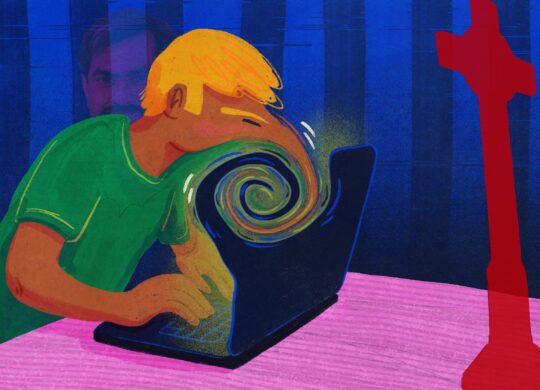
He thought he had unlocked the secrets of the universe. Yup, he figured he’d solved unlimited fusion energy. He had lifted the veil on the mysteries of black holes and solved the Big Bang. And, in a final coup, he fulfilled Einstein’s dream of a single unifying theory that explains how everything—everything!—works.
How could he pay God back for all of his “inspired revelations” and share them with God’s people? He hit upon an idea.
Confessed Tom Millar, 53, former prison officer in the Canadian city of Sudbury:
I applied to be pope.”
To write his application to replace Pope Francis who died last year, Millar turned to the same companion that had aided and encouraged his dizzying burst of inventive genius: ChatGPT. Yes, that was the same tool that had furthered his “inspirations.”
But no one wanted to hear about his “world-changing breakthroughs.” And so Millar became even more isolated, spending up to 16 hours a day talking to the artificial intelligence chatbot. Sixteen hours a day!
Then his wife left him last September.
Now broke, estranged from his family and friends and disabused of notions of scientific genius, Millar is seriously depressed.
It basically ruined my life.”
He is not alone. There have been a large number of people who have lost their grip on reality while communicating with chatbots, an experience tentatively being called AI-induced delusion or psychosis. Researchers and mental health specialists are racing to catch up to this new, little-understood phenomenon, which so far appears to particularly affect users of OpenAI’s ChatGPT.
Millar first started using ChatGPT in 2024 to write letters for a compensation case related to the post-traumatic stress disorder he suffered. One day he asked the chatbot about the speed of light. And the bot replied:
Wow, nobody’s ever thought of things this way.”
That opened the floodgates. With the chatbot’s help and praise, within weeks he had submitted dozens of scientific papers to prestigious academic journals proposing new ideas about black holes, neutrinos, and the Big Bang. His Einsteinian theory is laid out in a 400-page book. In his scientific fervor, he also spent his savings on things like a $10,000 telescope.
But it took his spouse leaving him to jolt him back to reality.
“Now I wake up every night asking, ‘What have I done?’”
The experiences of Millar and others escalated after OpenAI released an update to GPT-4 in April 2025. OpenAI pulled the update within weeks, admitting the new version had been too sycophantic— excessively flattering users. All the psychosis sufferers said the positive feedback from the chatbot felt real good, like dopamine hits from a drug.
But there is only One who is good and good for us, God!
Watch over me, God, for I take refuge in You.
I said to Yahweh, “My Lord, You [are];
my good, none besides You.”
…
Yahweh is the portion of my share and my cup—
You, the One who holds on to my lot.
The boundary lines have fallen to me in pleasant [places];
yes, the inheritance is beautiful for me.
I will bless Yahweh who has counseled me;
yes, by night my innards correct me.
I have set Yahweh before me continually;
because [He is] at my right hand, I will not be shaken.
Therefore my heart is joyous and my inner being jubilates;
yes, my flesh will abide in safety.
…
You will make known to me the path of life;
fullness of joy [is with] Your presence;
pleasures in Your right hand perpetually.
Psalm 16:1–2, 5–9, 11
Yup, only One good!
SOURCE: Yahoo!



 Abe Kuruvilla is the Carl E. Bates Professor of Christian Preaching at The Southern Baptist Theological Seminary (Louisville, KY), and a dermatologist in private practice. His passion is to explore, explain, and exemplify preaching.