
Thoughts!
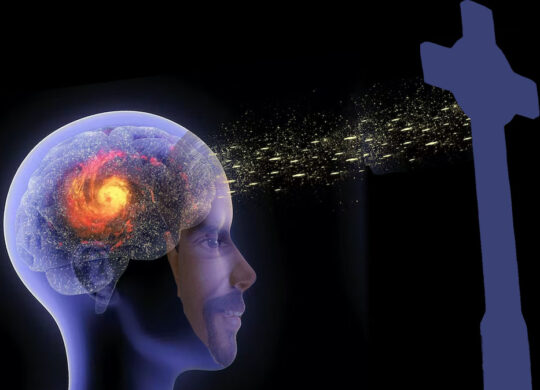
Wonderful stuff! A guy who had a stroke and was paralyzed totally, including the loss of ability to speak, can now communicate.
This was reported by neuroscientists and neurosurgeons from UCSF and UC Berkely a few weeks ago: “Generalizable Spelling Using a Speech Neuroprosthesis in an Individual with Severe Limb And Vocal Paralysis,” published in Nature Communications.
Electrodes were implanted the patient’s brain and he attempted to say code words that stood for each of the 26 letters of the English alphabet. If he wanted to “write” the letter A, he would think “Alpha,” and for “B,” “Bravo,” and so on (following the NATO phonetic alphabet).
They first tried to get the patient to think of the letter itself, but their system couldn’t distinguish between phonetically similar letters, such as “B,” “D,” and “P.” But silently “speaking” the NATO code words, the user generates brain activity that can then be decoded by algorithms as specific letters, and the software can then piece together the intended letters, insert spaces between words, and thus help others figure out what the paralyzed person was “saying.” To end a sentence, the user attempts to squeeze their right hand; this produces another distinct brain activity that tells the device to stop decoding. Fascinating stuff!
The fellow could produce sentences from a vocabulary of more than 1,150 words at a speed of 29.4 characters per minute, or about seven words per minute. Slow, but still … In fact, the speed could be considerably increased by getting the man to think whole words and generating distinct signals for each common whole word (not just letters). But this letter-decoding considerably expanded the vocabulary of the patient, beyond just common words already programmed in.
The man featured is the first participant in the Brain-Computer Interface Restoration of Arm and Voice (BRAVO) trial being conducted at UC San Francisco. The trial is open to adults who’ve lost significant speech and motor control due to conditions such as stroke, amyotrophic lateral sclerosis, or muscular dystrophy.
Our man, at the age of 20, had a severe stroke that cut off blood flow to a part of the brain stem called the pons, and as a result lost much of his ability to move his head, neck and limbs and all of his ability to produce intelligible speech. Until now, the man now could communicate only by using his limited head mobility to select letters on a screen using a physical pointer or a head-controlled cursor. Henceforth he just needs to think thoughts! And that just after 11 hours of training with the system (both training the patient and training the system).
Said Sean Metzger, PhD candidate in biogengineering at Berkely, and first author on the article:
For now, to connect to the decoder, the trial participant must be physically plugged into the device through a port that sticks up through the skin of his scalp. Ideally, in the future, the system will be completely wireless.”
Just like voice decoders, this brain-signal decoder, too, does make mistakes when translating brain activity into letters, but at an acceptable error rate of 6.13%.
But there is one Reader of thoughts who makes no mistake, is not error prone, and is perfect!
Yahweh, You have examined me and You know;
You—You have known my sitting and my rising;
You have understood my thought from afar.
My wayfaring and my lying down you have measured,
and [with] all my paths You are familiar.
For there is not a word on my tongue,
[and] behold, Yahweh, You have known it all.
Psalm 139:1–4
SOURCE:
Live Science; Nature Communications
 Abe Kuruvilla is the Carl E. Bates Professor of Christian Preaching at The Southern Baptist Theological Seminary (Louisville, KY), and a dermatologist in private practice. His passion is to explore, explain, and exemplify preaching.