
Cabal!
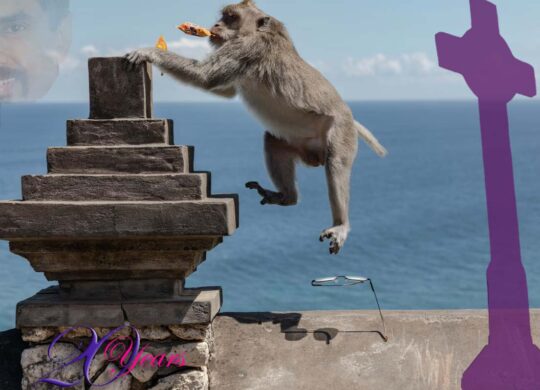
A few months ago, The Wall Street Journal reported on a most unusual criminal enterprise. In Bali, Indonesia.
Every week, this cabal steals dozens of phones, wallets, and other valuables from tourists in broad daylight and exchange them for handsome rewards. It’s been going on for decades and nobody’s been able to stop it.
Who makes up this criminal enterprise, this mafia? Long-tailed macaques. Yup!
Said Jonathan Hammé, 64, a London tourist, and victim of this primate syndicate:
The monkeys have taken over the temple. They’re running a scam.”
Uluwatu Temple is the hub of this monkey business. It is a Balinese Hindu temple on the south-western tip of the Bukit Peninsula in Uluwatu, Bali. (Yours faithful was on those premises last year, but escaped unscathed from the simian squad of stealers.) The temple is built at the edge (“ulu”) of a 230-foot rock face (“watu”) jutting out into the sea. Tourists come by the score, for the scenic beauty. The Hindu site dates back to at least the 11th century and the roughly 600 monkeys that inhabit it are considered by locals to be sacred guardians of the temple.
Mr. Hammé’s tale …
When he arrived at the temple with his wife, his tour guide handed him a stick, saying he would need it to fend off the monkeys.
I said, ‘What do you mean?’ I thought he was giving me a stick because he thought I was too old.”
Nope! While Mr. Hammé was admiring the vistas, a monkey jumped on his back, snatched his favorite sunglasses off his face and scampered up a tree. What stick?
The tour guide handed Mr. Hammé some Oreos, and hapless victim waved the cookies at the robber. Guess what? The thieving monkey jumped down, grabbed the Oreos and tossed back the sunglasses.
I didn’t expect that the monkeys would be operating like a gang taking everything. It was like—have you seen ‘Oliver Twist’?”
Animals steal dozens of items a week, including five to ten smartphones a day. The other day another sorry object of burglary was Taylor Utley, 36, from your blogger’s favorite city, Louisville, Kentucky. A monkey grabbed her phone out of her hand and hopped onto the ledge of a barrier separating the walkway from the cliff’s edge. That’s when a guide tossed the monkey a bag of fruit. The monkey held on to the phone. The handler gave it another bag, then another, and another. Finally, when the monkey couldn’t hold all the fruit, it dropped the phone.
Ms. Utley:
I was taken aback. It’s like a criminal enterprise of monkeys.”
Apparently these beastly bandits distinguish between objects that are highly valued (smartphones, prescription glasses, wallets) and those that aren’t (hats, flip flops, hair clips)—and will barter accordingly. So said researchers from Canada and Indonesia, who spent years filming the macaques and analyzing hundreds of hours of footage. And in “Acquisition of Object-robbing and Object/Food-Bartering Behaviours,” published by researchers from Canada and Indonesia in Philosophical Transactions B a few years ago. They concluded:
The monkeys have unprecedented economic decision-making processes.”
Golly!
This spontaneous, population-specific, cross-generational practice may be the first example of a culturally maintained barter-economy in free-ranging animals.”
Nobody likes thieves. God least of them.
He who steals must no longer steal, but rather he must labor,
working with his own hands what is good,
so that he may have [something] to share with the one having need.
Ephesians 4:28
No, don’t thieve, contributing to community-destruction. Instead, give, consolidating community-construction!
SOURCE: The Wall Street Journal; Philosophical Transactions B








 Abe Kuruvilla is the Carl E. Bates Professor of Christian Preaching at The Southern Baptist Theological Seminary (Louisville, KY), and a dermatologist in private practice. His passion is to explore, explain, and exemplify preaching.