
RaMbLeS
Welcome to RaMbLeS, a collection of weekly musings on life and Scripture. It all began in 2005 on Google’s blogspot as the aBeLOG (a name now recycled), a semi-autobiographical devotional that attempted to keep well-wishers abreast of my activities as I relocated to Scotland for a few years. Since my return, I’ve continued my RaMbLeS, and here’s its most recent incarnation on Homiletix, as random reflections usually based on current news articles and travel experiences and whatever else takes my fancy!
Giant!

Last week I blogged about “Shoulders!” and how we all stand on someone’s.
This week a giant with some incredibly broad shoulders went home to be with the Lord.
Dr. Howard G. Hendricks, affectionately known as “Prof” to thousands of his students and the many whose lives he influenced for Jesus Christ. There may be many professors at Dallas Theological Seminary, but there will only be one “Prof,” and he is now in a better place.
Shoulders!
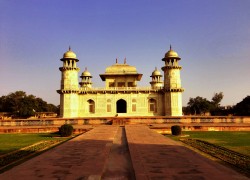
The tomb of I’timād-ud-Daulah is another gem in the city of Agra, India, home of the Taj Mahal.
This one is often called the “Baby Taj,” a prototype of the big gun.
It was completed in 1628, and is the transitional form, so to speak, between the Mughal Emperors’ earlier red sandstone constructions with marble decorations, and their later creations in white marble with decorative pietra dura inlays—the ornamental art that uses cut and fitted colored
Broke?

You thought you were broke? Zimbabwe has only $217 left!
The other week, Zimbabwe’s Minister of Finance, the Hon. Tendai Biti confessed that his nation had only US$217 (GB£138) left in its coffers after its civil servants had been paid.
Therefore, argued Mr. Biti, elections, due later this year, would not be held.
Nice excuse! The current President, Robert Mugabe, is widely acknowledged to be a “repressive authoritarian responsible for human rights abuses and severe
Entrance!
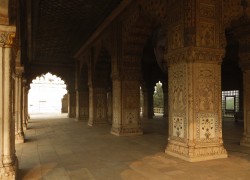
Most ancient forts in India have a Diwan-i-Khas, the Hall of Private Audiences, the place where the ruler conducted meetings with royal courtiers and state guests.
So also in the Red Fort (Lal Qil’ah) in Delhi, one of the most fascinating of all such edifices in the country. “Red,” because of the extensive use of red sandstone for the massive walls that surround it. The fort dates back to the 17th century and was built by the Mughal emperor, Shah Jahan—yup!
Dying?
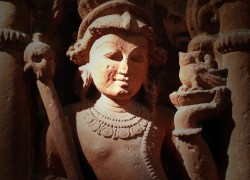
Visiting the National Museum in New Delhi recently, I came across this sculpture dating back to the 10th century.
This is Yama (यम in Sanskrit), the lord of death in Hinduism. (Actually one finds this god also in Sikhism, Buddhism, in Chinese, Tibetan, Korean, and Japanese mythology, as well as in Iranian/Zoroastrian tradition.)
And no wonder. Humankind has always worried about death. What happens afterwards? Speculations have abounded fueling most of the after-life
Irony!
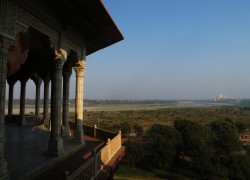
The Agra Fort, another UNESCO World Heritage site, dates back to early 1100s. It was captured and fortified by the Mughal emperor of India in the late 1500s, Akbar, the grandfather of Shah Jahan—the one who had the Taj Mahal constructed as a mausoleum for his favorite wife, Mumtaz Mahal. The fort is about 2 miles away from the Taj. But grandfather and grandson had different proclivities: the former liked his buildings, including the Agra Fort, in red sandstone, the latter
Memorial!
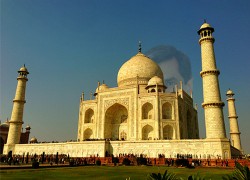
Besides the teaching and preaching and connecting with friends, the highlight of my recent trip to India has got to be the Taj Mahal. While I had seen it from afar in the past, this was the first time I got to go inside the complex that includes not only the white-domed masterpiece but a number of other structures and gardens.
Truly an incredible sight!
No matter where in Agra you are, you can see it on the banks of the R. Yamuna, and no matter what angle you view it from,


 Abe Kuruvilla is the Carl E. Bates Professor of Christian Preaching at The Southern Baptist Theological Seminary (Louisville, KY), and a dermatologist in private practice. His passion is to explore, explain, and exemplify preaching.