
Drink?
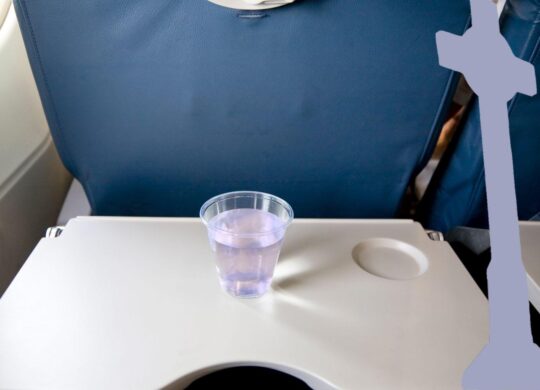
An Airline Water Study was released recently by the Center for Food as Medicine and Longevity (CFM&L). The news ain’t good.
The study ranked 10 major and 11 regional airlines for their water quality on flights, as gauged during the last three years. Each airline was given a Water Safety Score (from 0, lowest, to 5, highest). Five criteria were assessed: violations per aircraft, violations for E. coli bacteria, public notices per 100 aircraft, indicator-positive rates (i.e., total coliforms—bacteria from the large intestine—but excluding E. coli), and disinfecting and flushing frequency of aircraft water tanks (supposed to be undertaken at least four times a year; or, if less often, tanks are to be tested monthly). A score of 3.5 (a grade of A or B), or better, indicated that the airline had relatively safe, clean water and earns a Grade A or B.
Announced Dr. Charles Platkin, Director of the CFM&L:
Delta Air Lines (5.0; Grade A) and Frontier Airlines (4.80; Grade A) won the top spots with the safest water in the sky, and Alaska Airlines finished No. 3 (3.85; Grade B). The airlines with the worst score were JetBlue (1.8; Grade D) and American Airlines (1.75; Grade D). And nearly all regional airlines need to improve their onboard water safety, with the exception of GoJet Airlines which was No. 1 (3.85; Grade B). Mesa Airlines finished last (1.35; Grade F).”
Unhealthy water violates the federal government’s Aircraft Drinking Water Rule (ADWR), which was implemented in 2011 and requires airlines to provide passengers and flight crew with safe drinking water. And penalties are applied for inadequate responses to public notice requirements, specifically when airlines fail to clearly turn off contaminated water systems or provide alternative drinking water.
But the study also found that the Environmental Protection Agency (EPA)—one of the federal agencies responsible for ensuring safe aircraft drinking water—rarely levies civil penalties to airlines in violation of the ADWR. So the EPA got the “Shame on You” award (yes, the study did give it out)!
From the official report of the CFM&L:
Commercial aviation serves as an essential mode of transportation for hundreds of millions of passengers annually in the United States. While considerable attention has been devoted to aviation safety in terms of mechanical reliability and operational procedures, the quality and safety of drinking water available to passengers and crew during flight remains a less visible but important public health consideration.”
Quite encouraging!
So here’s the bottom-line advice from the Center for Food as Medicine and Longevity:
NEVER drink any water onboard that isn’t in a sealed bottle. Do not drink coffee or tea onboard. Do not wash your hands in the bathroom; bring an alcohol-based hand sanitizer containing at least 60% alcohol instead.”
Deliver me, God, for the waters have gone in, [up] unto my neck. …
I have gone in to depths of waters, and a torrent has flooded me.
…
Rescue me from the mud and do not let me sink;
may I be rescued from those hating me and from the depths of waters.
May it not flood me, the torrent of waters; and may it not swallow me, the deep.
Psalm 69:1–2, 14–15
Then God …
He sent from on high, He took me;
He pulled me out of many waters.
Psalm 18:16
And now, …
In grassy pastures He makes me lie;
by restful waters He leads me.
Psalm 23:2
Therefore, …
As the deer pants for the streams of water,
so my soul pants for You, God.
Psalm 42:1
SOURCE: Center for Food as Medicine and Longevity







 Abe Kuruvilla is the Carl E. Bates Professor of Christian Preaching at The Southern Baptist Theological Seminary (Louisville, KY), and a dermatologist in private practice. His passion is to explore, explain, and exemplify preaching.