
Frozen!
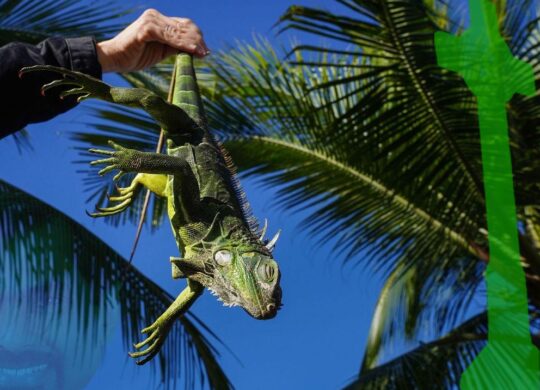
As with most of the continental United States, Florida, too, has been experiencing record low temperatures in the last couple of weeks. The other day, the mercury dipped to 25ºF (-4ºC), the lowest ever recorded in February in at least a century.
All kinds of problems occur in temperatures such as these: frozen pipes that burst and flood homes (yup, been there, done that: see here), all kinds of aches and pains (tell me about it!)—oh, and snow-shoveling injuries (your faithful blogger, a sexagenarian, dug himself out of over a foot of accumulated snow last week, disregarding medical advice to refrain from such activities if one is over 50: thankfully, I survived, heart and limbs intact).
Then there are power failures, infections, motor vehicle accidents, livestock stress, etc. Of course, most seriously, human fatalities can occur: over 110 have already been reported across the country.
But Florida experienced a strange kind of cold-weather misfortune. It rained iguanas! Yes, iguanas!
Experts estimate the invasive green iguana population in Florida ranges from one million to tens of millions, mostly concentrated in South Florida. These herbivorous lizards, that can grow up to 4–6 feet in length, are not native to Florida; they are indigenous to Central America, tropical South America, and some Caribbean islands. They first appeared in Florida in the 1960s and the speculations are that they came from the exotic pet trade (released by owners when they grew too large or aggressive to domesticate), by stowing away on cargo ships, or by escaping from facilities (Hurricane Andrew a few decades ago destroyed exotic animal breeding facilities enabling the escape of these creatures).
Iguanas generally begin to struggle when temperatures drop below 50ºF (10ºC), and prolonged exposure to temperatures in the 30s or low 40s can be fatal. Because they are cold-blooded, they rely entirely on external heat to maintain their body functions. Below 50ºF they become sluggish and lethargic; below 45ºF, they get “cold-stunned” and lose muscle control and their grip on branches where they are usually found. And … it rains iguanas.
Blake Wilkins and Andrew Baron, professional iguana trappers reported last week:
We have already collected about 2,500 iguanas! We’ve never seen anything like it in our years of trapping.”
Floridians have been encouraged to pick up and take the reptiles to collection sites to be humanely euthanized or transferred to licensed permit holders for sale outside the state.
Florida’s Fish and Wildlife Conservation Commission (FWC) issued an executive order allowing people to transport iguanas—illegal at other times without a permit—to FWC offices.
Said Col. Roger Young, the FWC executive director:
It’s the first time we’ve ever done this with an ‘iguana executive order.’”
One social media, made a wise crack:
Thanks, Gov. Ron DeSantis, making iguana stacking a fun new frozen Floridian family tradition!”
Psalm 147:17 echoes the sentiments of ye olde State of Florida, describing God as …
… the One casting [forth] His ice like fragments—
before the face of His ice-coldness who can stand?
Psalm 147:17
We can’t. So seek warmth. In him, for he is also …
… the One healing the brokenhearted, and the One binding their wounds;
the One counting the number of the stars: all of them [by] names He calls.
Great is our Lord and abundant in power;
[as] to His understanding, there is no number[ing of it].
Yahweh is the One taking pleasure in those who fear Him,
the ones hoping for His lovingkindness.
Psalm 147:3–5, 11
Fear him. Hope in him. And use those blankets.
SOURCE: The Telegraph









 Abe Kuruvilla is the Carl E. Bates Professor of Christian Preaching at The Southern Baptist Theological Seminary (Louisville, KY), and a dermatologist in private practice. His passion is to explore, explain, and exemplify preaching.