
Shoes!
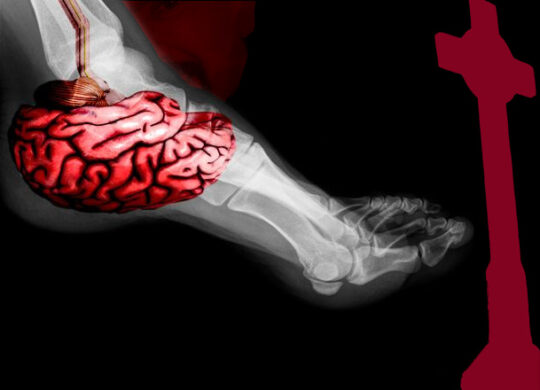
Athletic footwear has entered a new era of ambition. Here’s what Nike claimed a few months ago: “Nike Debuts its First Neuroscience-Based Footwear to Help Athletes Feel Calm, Focused and Present.” Wow! Footwear and the brain!
No longer content to promise just comfort or performance, Nike claims its shoes can activate the brain, heighten sensory awareness and even improve concentration by stimulating the bottom of your feet.
Nike’s chief science officer, Matthew Nurse, in the company’s press release for the shoes:
By studying perception, attention and sensory feedback, we’re tapping into the brain-body connection in new ways. It’s not just about running faster—it’s about feeling more present, focused and resilient.”
On the surface, it seems to make a lot of sense. After all, there are a lot of sensory receptors on the feet. And, of course, they communicate with brain. So, perhaps, stimulating those receptors really do sharpen the mind?
A neurosurgeon had something to say about this, Dr. Atom Sarkar, of Drexel University:
I’ve found that neuroscience suggests the reality is more complicated—and far less dramatic—than the marketing implies.”
Besides detecting pressure, vibration, texture and movement, the foot also influences proprioception—the brain’s sense of where the body is in space—which relies on input from muscles, joints and tendons, using them to keep one balanced, upright, and stable. And secondarily, because posture and movement are tightly linked to attention and arousal, changes in sensory feedback from the feet can influence how stable, alert, or grounded a person feels.
Said Dr. Sarkar:
Minimalist shoes, with thinner soles and greater flexibility, allow more information about touch and body position to reach the brain compared with heavily cushioned footwear. In laboratory studies, reduced cushioning can increase a wearer’s awareness of where their foot is placed and when it’s touching the ground, sometimes improving their balance or the steadiness of their gait. However, more sensation is not automatically better. The brain constantly filters sensory input, prioritizing what is useful and suppressing what is distracting. Sensory stimulation can heighten awareness, but there is a threshold beyond which it becomes noise.”
So whether sensory footwear can improve concentration is where neuroscientists become especially skeptical. Focus, attention and executive function depend on other neural networks involving various areas of the brain, as well as on hormones that modulate the nervous system.
Dr. Sarkar:
Some studies suggest that mild sensory input may increase alertness in specific populations—such as older adults training to improve their balance or people in rehabilitation for sensory loss—but these effects are modest and highly dependent on context.”
In other words, feeling more sensory input from the foot (or anywhere else) does not mean the brain’s attention systems are working better.
Of course, if someone believes a shoe improves focus or performance, then that belief alone can change perception and behavior, and sometimes change perception and behavior enough to produce measurable effects.
Opined our neurosurgeon:
In the end, believing a product gives you an advantage may be the most powerful effect it has.”
Nike may not help our feet, but God does!
For who is God, except Yahweh? and who is a rock, besides our God—
the God who girds me with strength and makes my path blameless?
He makes my feet like deers’ [feet].
Psalm 18:31–33
And makes we walk with him:
For You have rescued my soul from death, my eyes from tears, my feet from stumbling.
I will walk before the face of Yahweh in the lands of the living.
Psalm 116: 8–9
Thank God for feet!
SOURCE: StudyFinds; The Conversation








 Abe Kuruvilla is the Carl E. Bates Professor of Christian Preaching at The Southern Baptist Theological Seminary (Louisville, KY), and a dermatologist in private practice. His passion is to explore, explain, and exemplify preaching.