
Weights!
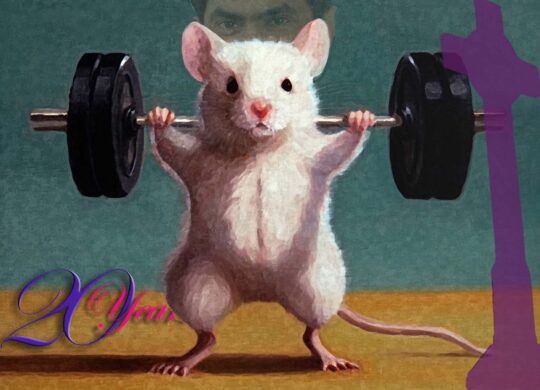
Mice are now weightlifting! Yup, rodents. And apparently it’s been good for those critters, too.
So saith scientists from the University of Virginia in “Weightlifting Outperforms Voluntary Wheel Running for Improving Adiposity and Insulin Sensitivity in Obese Mice” published in Journal of Sport and Health Science recently.
Mice were fed a high-fat diet for eight weeks. Different groups either lifted weights, ran on wheels, or remained sedentary.
You are probably wondering how the researchers got mice to lift weights. I was, too.
We developed a novel weightlifting system for the study. Mice wore small collars and had to lift a weighted cage lid in a squat-like motion to reach their food. The weight started at 100% of each mouse’s body weight and increased by 20% daily until reaching 240% of body weight, where it remained for the study duration. Mice averaged 231 lifts per day.”
(Make them run was easier: the treadmill.)
And then the animals were “doped” with sugar and evaluated for how quickly their blood glucose levels returned to normal. Weightlifting mice cleared glucose faster than sedentary mice, while running mice showed only partial improvement. Or they were injected with insulin and the blood sugar response measured.
The weightlifters won the contest! Weightlifting proved superior when scientists tested insulin sensitivity and glucose tolerance, key markers that predict diabetes risk. Besides, it more effectively reduced dangerous fat around internal organs (though running uniquely increased calorie-burning brown fat).
Surprisingly, all these metabolic improvements happened without measurable muscle growth, suggesting something changed inside muscle cells other than the size thereof. So when folks say exercise (mostly of the endurance kind) is one of the most effective treatments for obesity and type 2 diabetes, to be performed multiple times a week, maybe we should be looking closely at the resistance kind of exercises (using weights, etc.). These enhance what is called “anabolic sensitivity,” muscle tissue becoming more responsive to insulin and other factors. And improving muscle insulin sensitivity appears to have large effects on whole-body glucose metabolism.
The authors:
These results provide a direct and translatable comparison of endurance and resistance exercise training in a preclinical context of obesity and hyperglycemia. The current data set demonstrates an advantage of resistance exercise over endurance exercise in improving glucose and insulin tolerance under the condition of obesity, and that these improvements are independent of significant alterations of muscle weight gain and exercise performance.”
So that’s what we need, the mighty mice teach us: weightlifting!
But the Bible says not all “weights” are good!
… my iniquities have gone over my head;
like a heavy weight they weigh too much for me.
My wounds stink, they putrefy, because of my folly.
I am bent over, I am brought low utterly;
all day going about, I am darkened. …
I am prostrated and crushed utterly;
I wail from the groaning of my heart.
Psalm 38: 4–6, 8
Iniquities, of course, ain’t good. Neither is the weight of God’s hand upon the iniquitous:
When I kept silent, my bones wasted away
through my groaning all day long.
For day and night Your hand was heavy upon me.
Psalm 32:3–4
The solution?
My sin I acknowledged to You, and my iniquity I did not cover;
I said, “I will confess my rebellions to Yahweh”;
and You—You pardoned the iniquity of my sin.
Therefore, let everyone who is devout pray to You.
Many are the pains of the wicked,
but he who trusts in Yahweh, lovingkindness shall surround him.
Psalm 32:5–6, 10
No more of those weights!
SOURCE: Study Finds; Journal of Sport and Health Science







 Abe Kuruvilla is the Carl E. Bates Professor of Christian Preaching at The Southern Baptist Theological Seminary (Louisville, KY), and a dermatologist in private practice. His passion is to explore, explain, and exemplify preaching.