
Wonder!
Writes The Washington Post columnist Dana Milbank:
I just had a most eventful week. I watched in horror as a terrible storm in the Mediterranean dashed a ship against a rocky coast, forcing its crew and passengers into a desperate attempt to save themselves and rescue their cargo. I soared with the birds among snow-covered peaks in the Rockies, marveling at the many shades of white and blue. And I joined picnickers on a serene hillside along the Hudson River, where I watched the sunlight and clouds play above a sheep pasture and a tiny village beyond it.”
Milbank was describing the “Finding Awe” tour that he partook of, at the National Gallery of Art in Washington, D.C.
I unlocked a sense of wonder I did not know I could feel while looking at art—a shipwreck scene by Claude-Joseph Vernet, an abstraction by Georgia O’Keeffe, and a landscape by Jasper Francis Cropsey.”
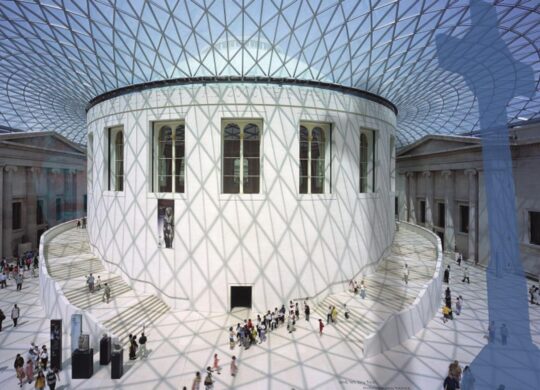
I did, too. On my way to Hong Kong and Singapore to teach last month, I thought I’d go via London and spend a couple of days in the British Museum where I hadn’t been since my Scotland days two decades ago. And the National Gallery in London. Altogether I walked 6.2 miles (about 10 km) just within those two buildings. Oh, the beauty of the exhibits. The ingenuity of humankind. Its creativity. The … wonder!
And, since I was going to London from New York City, I decided I’d spend a few days in the Big Apple to take in its museums, as well. So: The Met, The Morgan Library and Museum, The Frick Museum, and The Brooklyn Museum. Just amazing! The wonder!
Recent research from King’s College, London, “The Physiological Impact of Viewing Original Artworks vs. Reprints: A Comparative Study,” showed that participants who viewed works by Gauguin, van Gogh, Manet, and de Toulouse-Lautrec for just 20 minutes, showed a 22% drop in the stress hormone cortisol level, while markers of inflammation dropped even more sharply and heart rhythms indicated greater relaxation.
Said National Gallery of Art Director, Kaywin Feldman:
In some ways I think it’s actually easier if you don’t have an understanding of the art, because that moment of ‘Oh, my goodness’ is part of wonder. You have to sort of stop in your tracks, have that moment of surprise.”
I had so many—so many of those, while seeing a ton of Rembrandts,Renoirs, Canalettos, Monets, the Rosetta Stone, the Benin Bronzes, Egyptian mummies, ….
Milbank confesses:
The point is not to see it all but to see a few things, or even one thing, deeply. I was doing it all wrong.”
Well, I did see a lot of things, but probably only about a fifth of the ongoing exhibits in all those museums, focusing only on things that interested or moved me. And there was so much of that!
University of California at Berkeley psychologist Dacher Keltner adds:
Simply slowing down to take in the simple beauties around us is an antidote to the moral ugliness of our attention-captured, online life.”
Yes, indeed, awed we must be, often, especially as we realize we’re children of the Creator God from whom humanity has inherited a sliver of creativity!
For You are great and the One doing wonders; You—You alone are God.
Psalm 86:10
Uncover my eyes, and I will regard wonderful things from Your law.
Psalm 119:18
Blessed be Yahweh God, God of Israel, alone working wonders.
And blessed be His glorious name forever; and may His glory fill all the earth.
Amen and amen.
Psalm 72:18–19
SOURCE: Washington Post


 Abe Kuruvilla is the Carl E. Bates Professor of Christian Preaching at The Southern Baptist Theological Seminary (Louisville, KY), and a dermatologist in private practice. His passion is to explore, explain, and exemplify preaching.