
Autopilot!
You wake up, brush your teeth, make coffee, check your phone, tend to your kids, perform your ablutions, eat your cereal, drive to work, …. How much of that morning routine did you actually think about? According to new research, the answer is … almost none of it.
So claim scientists from University of South Carolina, SC, Central Queensland University, Rockhampton, Australia, and University of Surrey, Guildford, UK, in “How Habitual is Everyday Life? An Ecological
Bliss!
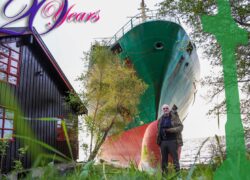
A strange thing happened a couple of months ago.
A cargo ship crashed into a guy’s front garden. Yes, his front garden. That’s because his house was close to the edge of the water. And because said cargo ship—all 450 feet of it—ran aground. In the Trondheimsfjord off Byneset in Trondheim, Norway.
And our man’s bedroom was only a few feet away from the stern of the ship. He is safe.
But here’s the strange fact: Johan Helberg had been sound asleep when the catastrophe
Seeing!
You wanna be able to see in total darkness? Without night vision devices? Now you can.
And scientists from University of Science and Technology of China (Hefei), Fudan University (Shanghai), and University of Massachusetts (Worcester) tell you how. In “Near-Infrared Spatiotemporal Color Vision in Humans Enabled by Upconversion Contact Lenses, published in the prestigious journal, Cell, a couple months ago.
Yeah, well, almost without night vision devices, since
Bored!

Boredom, apparently, is a widespread problem. Even in spiritual practices and institutional rituals. These have now been found to be wanting: They are … boring!
So pronounced social researchers from Europe and Australia in “Spiritual Boredom is Associated with Over- and Underchallenge, Lack of Value, and Reduced Motivation,” published earlier this year in Communications Psychology. They investigated spiritual boredom in five different spiritual contexts:
2 Timothy 4:1–22

The people of God solemnly preach God’s word at every opportunity, despite opposition and suffering, as they follow the example of godly leaders, asserting their lifelong faithfulness to God and to their ministries, confident of ultimate deliverance and eternal rewards.
It is apparent that the entire pericope is written with much emotion, expressing the characteristics of the apostle’s “last will and testament.”
While there are five second person imperatives in 4:2—“preach,”
 Abe Kuruvilla is the Carl E. Bates Professor of Christian Preaching at The Southern Baptist Theological Seminary (Louisville, KY), and a dermatologist in private practice. His passion is to explore, explain, and exemplify preaching.