
Arms!
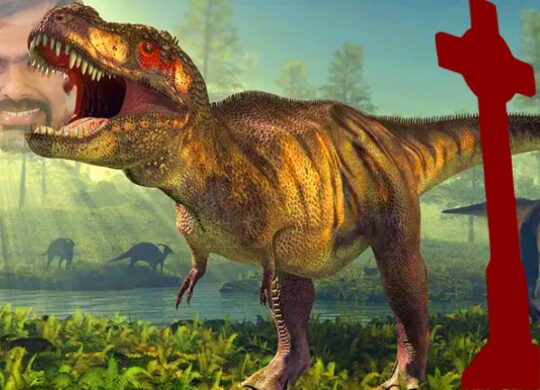
One of the mysteries of Tyrannosaurus rex is its relatively small arms.
T. rex was a bipedal carnivore with a massive skull balanced at the other end with a long, heavy tail … and short arms. This beast was about 40 feet long, 12 feet tall, and weighed about 8 tons! But its arms? A mere 3 feet long! Apex predator alright, but with … short arms, less than a third of the length of the dinosaur’s legs and looked noticeably disproportionate in a huge body.
This oddity may have been solved by scientists from University College, London, and the University of Cambridge, in “Drivers and Mechanisms of Convergent Forelimb Reduction in Non-Avian Theropod Dinosaurs,” published in Proceedings of the Royal Society B earlier this year. Based on an analysis of 85 species of dinosaurs, by measuring the forelimbs and skull bones from the pool the authors concluded that tiny arms were an evolutionary trade-off caused by another body part becoming ever larger and taking up resources—the skull. Big head, small arms. And this correlated among a number of dinosaur species.
Charlie Roger Scherer, a doctoral student at University College London and the study’s lead author:
If you’re a dinosaur with a very strongly put together skull, chances are you’re going to have very small forelimbs. And it doesn’t really matter how big you are—you could be 1 ton in weight, or 10 tons in weight. If you have a strong skull, you’re going to have relatively small arms.”
The reason?
Evolution doesn’t like to have everything all at once, because it tends to prioritize one thing over another. If you want to focus on using your head to bring down large prey, you don’t really want to be putting much effort in keeping your arms long and with claws, because you’re probably not really going to need that, so evolution kind of says, ‘We don’t need the arms anymore, so let’s shrink them down and put more energy into keeping the skull strong and using that as the primary weapon.’”
Previous research already suggested a link between shrinking forelimbs and growing skulls in carnivorous dinosaurs, but this new study is the first to identify this trend in five different groups of dinosaurs and provide statistical support. Shrinking limbs were apparently not a fluke, but an evolutionary trait that occurred across different, unrelated species over an extended period.
Scherer:
As their prey became larger, these animals upped the ante by making their primary weapon bigger and more powerful, draining resources away from arms and claws. Everything was approached headfirst, so the head just became what came into contact with the prey, and that was the easiest way to bring them down, as opposed to jumping around or fighting with claws.”
T. rex basically became a giant land shark that did all its work with its huge head.
But the arm of God? Long, powerful, and unsurpassable!
Yahweh, God of Armies, who is like You, mighty Yah?
And Your faithfulness surrounds You.
You rule the pride of the sea;
when its waves rise, You—You calm them.
You—You crushed Rahab like one slain;
with the arm of Your might You scattered Your enemies.
To You [belong] the heavens, even to You the earth;
the world and what fills it, You—You have founded them. …
To You [belongs] an arm with strength;
Your hand is mighty, Your right hand is exalted.
Psalm 89:8–11, 13
SOURCES (of ideas, numbers, and words): CNN Science; Proceedings of the Royal Society B
 Abe Kuruvilla is the Carl E. Bates Professor of Christian Preaching at The Southern Baptist Theological Seminary (Louisville, KY), and a dermatologist in private practice. His passion is to explore, explain, and exemplify preaching.