
Joy!
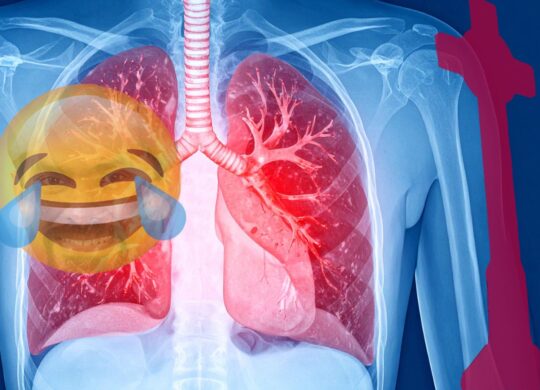
If you are one of those patients with chronic obstructive pulmonary disease (COPD), then you should laugh, they say, for your own health. “They,” meaning, researchers at Hacettepe University and Ankara Yıldırım Beyazıt University, Turkey. Or so they claimed in “Effect of Pursed-Lip Breathing and Laughter Therapy … in Individuals With Chronic Obstructive Pulmonary Disease,” that was presented recently at the European Respiratory Society Congress in Barcelona. No laughing matter, this.
Dr. Goncagul Aldan, one of the authors:
COPD is a serious lung disease affecting millions of people worldwide [12 million in the US] and is a leading cause of disability and death. Laughter therapy had already shown promising results in a number of other chronic conditions. Its accessible, enjoyable nature suggests it could equally benefit COPD patients, not only in coping with the daily stress of living with a chronic illness, but also in directly supporting their respiratory health.”
The study included 63 people with COPD being treated at Ankara Bilkent City Hospital, Türkiye. One third of patients were randomly assigned to laughter therapy, one third to pursed-lip breathing (exhaling slowly through pursed lips) exercises and one third to no breathing exercises.
For the laughter therapy, patients were taught how to do a series of exercises including rhythmic clapping with vocal sounds; playful laughter exercises, such as mimicking a motorcycle starting or a lion’s roar; a laughter meditation with spontaneous unforced laughter, and a relaxation with calm breathing and smiling. Subjects were asked to practice for 30 minutes, three times per week for eight weeks.
After the treatment period, patients having laughter therapy and patients using pursed-lip breathing exercises had less difficulty breathing, compared with the patients who had not been doing either breathing exercise.
Dr. Aldan:
The results of this study show that both pursed-lip breathing exercises and laughter therapy can significantly reduce the severity of breathlessness in COPD patients, and this effect was sustained, even a month after the program ended.”
Laughter therapy offers an effective low-cost treatment that patients can practice at home without any equipment or specialist support, alongside their other treatment.
And it’s not just laughter’s exercising of those breathing muscles, promoting deeper exhalation. But the general feeling of joy may trigger the release of endorphins, offering both physical and emotional relief. Laughter therapy aims to evoke the effects of genuine laughter in the body.
Genuine laughter, though, is the ultimate kind, God-induced:
When Yahweh restored the restoration of Zion, we became like dreamers.
Then it was filled with laughter—our mouth, and our tongue with joyful exclamation.
Then they said among the nations, “Great things Yahweh has done for them.”
Great things Yahweh has done for us; we became rejoicers.
Psalm 126:1–3
Yes, true joy (and laughter) comes with God restoring our dire and desperate situations (whatever they might be) to his shalom. And the psalmist celebrates that restoration with rejoicing.
But, it is not over yet. In real life, there is still restoration to be done, there is still brokenness to be undone, there is still grief to overcome. And so the psalmist continues, with a plea:
Restore, Yahweh, our restoration, like streams in the South.
The ones sowing in tears, in joyful exclamation they will reap.
He goes, going and weeping—the one carrying a bag of seed;
he shall come, coming with a joyful exclamation—the one carrying his sheaves.
Psalm 126:4–6
Yes, one day. (Re-)Restoration is coming. In fact, this last state will better than the first—for then we’ll be free from the very presence of sin.
And this restoration will last forever, praise God!
SOURCE (of ideas, numbers, and words): European Respiratory Society


 Abe Kuruvilla is the Carl E. Bates Professor of Christian Preaching at The Southern Baptist Theological Seminary (Louisville, KY), and a dermatologist in private practice. His passion is to explore, explain, and exemplify preaching.