
Kids?
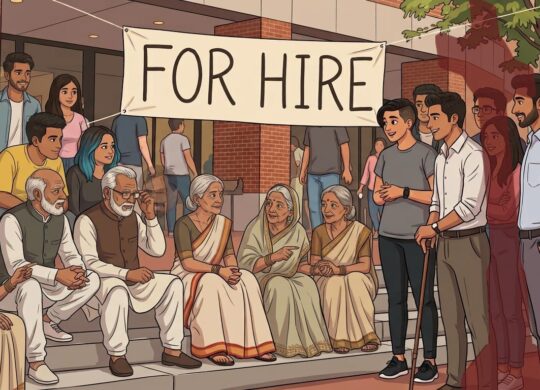
A recent article in The Washington Post had something interesting to say about a new industry in China: Adult children for hire!
An aging population in China is inspiring this trend and enterprising young men and women are making themselves available for hire as companions to lonely elders in their day-to-day activities. The historic demographic shift is driven by: declining fertility = ~1 birth/woman (you need it to be at least 2.1 to maintain a stable population); birth rate = 5.62/1,000 people (the lowest recorded in modern Chinese history); population over 60 = 23%, and over 65 = 16% (together = more than half a billion people!); population shrinkage for consecutive years with deaths (11.3 million) more than births (8 million).
Li Xunlei, chief economist at Zhongtai Financial International:
By 2031, China will be a super-aged society, one in which 20 percent or more of the population is over 65. A rapid increase in my country’s aging population rate is inevitable before 2050. Even if the birth rate rebounds significantly, it would do little to slow the acceleration.”
So there you have it. A new industry: youngsters, in their 20s and 30s, becoming “outsourced” children. They provide companionship rather than medical care, visiting, chatting, helping clients set up smartphones, accompanying them to medical appointments, etc.
And the going rate on Chinese social media is between $29–88 for a three-hour session.
And there are placement agencies for this enterprise! un Shuyang, 28, works for Happy Home, a start-up one:
Most of our clients live alone while their adult children work in distant cities, and they struggle with feelings of isolation and fear of death. By talking to young people, they can regain a sense of vitality and feel more energetic.”
Some question whether emotional support in this form should be monetized. In China, filial piety is a core virtue; children traditionally are required to respect, obey and care for their parents.
But Janice Ye, a 36-year-old teacher in Suzhou, who hires Time Bank companions to visit with her parents, said:
They are not in conflict. If someone can accompany your elderly parents and keep them happy, I don’t see anything wrong with that. It eases their inner loneliness.”
Still, Liu Cheng, the founder of another agency, Time Bank, said:
Children are no replacement for family. But if we can meet their needs, people will eventually accept our services. … We are envisioning a future where senior home care is as easy as ordering takeout.”
Yup, children are irreplaceable. And are not at all like ordering takeout.
Behold, sons are a heritage of Yahweh;
the fruit of the womb is a reward.
Psalm 127:3
So are daughters, too, of course. While the Hebrew noun in 127:3a, 4b can be translated “children,” it appears that “sons” are primarily the focus here, bastions of security and defense, as the subsequent verses show. However, in applying this text, we should extend “sons” to children of both genders.
Like arrows in the hand of a mighty one,
thus are the sons of youth.
Blessing [upon] the mighty one
whose quiver He has filled with them;
they will not be ashamed
when they speak with their enemies in the gate.
Psalm 127:4–5
I think the martial imagery is metaphorical here and not intended to be taken literally. It can be extended to indicate all kinds of positive influence upon society by children who are well-trained by their parents and who bring them honor. Irreplaceable kids … and parents!
SOURCE (of ideas, numbers, and words): The Washington Post









 Abe Kuruvilla is the Carl E. Bates Professor of Christian Preaching at The Southern Baptist Theological Seminary (Louisville, KY), and a dermatologist in private practice. His passion is to explore, explain, and exemplify preaching.